As generative AI moves from cloud-based services toward on-device deployment, AI PCs, mini PCs, and personal workstations are facing new demands for coordination among computing, memory, and storage. Model weights, long-context data, and KV Cache generated during inference are changing the role storage plays in personal computing. ORICO, a technology brand with longstanding experience in data storage, is preparing to launch the new FlashMem AI SSD FM9800. By combining dedicated AI cache space with conventional storage, the product expands ORICO’s exploration of local AI storage.
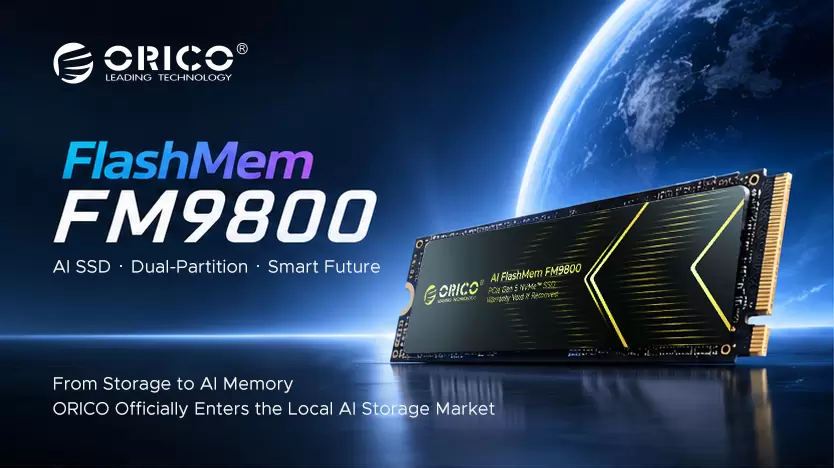
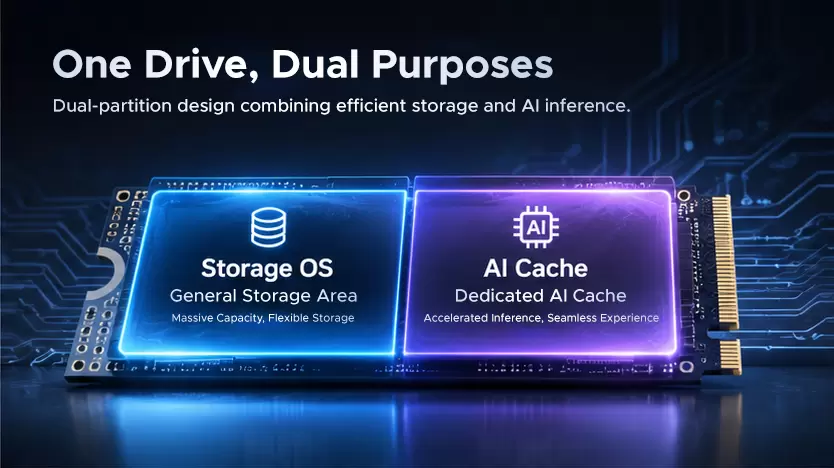
The FlashMem FM9800 is a PCIe 5.0 M.2 2280 solid-state drive designed by ORICO for edge AI workloads. Unlike a conventional SSD that primarily stores operating systems, applications, and files, FlashMem allocates dedicated space for AI caching alongside regular storage. Its dual-partition design enables one SSD to serve both everyday storage needs and local AI inference caching workflows.
At the product level, the FM9800 divides its capacity into a Storage OS area for general-purpose storage and an AI Cache area dedicated to AI workloads. The Storage OS area can hold the operating system, applications, and personal files. The AI Cache area is designed for local AI runtime requirements and can accommodate selected model weights, context data, and other data involved in inference. The two areas use separate wear-management strategies and read/write scheduling mechanisms to better accommodate their different workload characteristics.
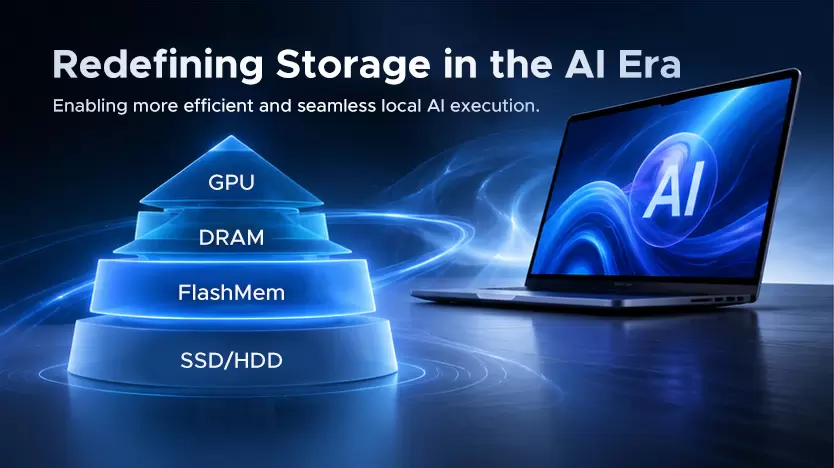
On the software and technology side, FlashMem FM9800 works with AI storage middleware and the Herdsman local inference engine. Together, they are designed to coordinate data across GPU memory, system memory, and AI flash cache as a tiered memory hierarchy. For supported workloads, data that does not need to remain in high-speed memory at all times can be placed in the AI cache layer, providing more flexible capacity for local model execution. Actual results depend on the host platform, engine version, model, quantization method, context length, and other workload conditions.
The product is not intended as a universal upgrade for every PC user. It is designed for users who want to deploy AI models locally and whose devices meet the required compatibility conditions. For example, on systems based on the AMD Ryzen AI Max+ 395 platform, the unified-memory configuration may not be upgradeable after purchase. When users attempt to run larger models or longer-context tasks, available memory can become a constraint. In professional fields such as legal services, healthcare, R&D, and finance, users may also need to process contracts, medical records, code, and internal documents locally to reduce the need to transfer sensitive data to external services. FlashMem is intended to provide these users with another way to expand the storage tiers available to their existing systems.
The FM9800 uses an M.2 2280 form factor, a PCIe 5.0 interface, and 3D TLC NAND. It will be available in 1TB and 2TB capacities. The 1TB version allocates 85GB to AI Cache and 768GB to the Storage OS area; the 2TB version allocates 128GB to AI Cache and 1,638GB to the Storage OS area. A graphene thermal pad is included to help dissipate heat from the controller and NAND components. Endurance ratings, warranty terms, and final performance figures will be provided in ORICO’s official product specifications and test documentation.
The launch of FlashMem FM9800 also reflects the continued evolution of ORICO’s storage business. With a long-standing focus on data storage and transfer, ORICO is extending its portfolio beyond traditional storage products into high-performance storage workflows and local AI Memory applications.
In ORICO’s view, storage in the AI era will do more than preserve files and expand capacity. It may also become an increasingly important part of the local computing architecture. ORICO will continue to explore flash technology, high-speed interfaces, AI storage, and hardware-software collaboration, developing more storage and computing expansion options for creators, professional users, and local AI applications.